
Merchant Services Resources and Guides
At Bespoke Merchant Solutions, we want to help you navigate the increasingly complex landscape of merchant services. Stay informed on the latest regulations, trends, and news with our dedicated customer resources page.
Helpful Guides
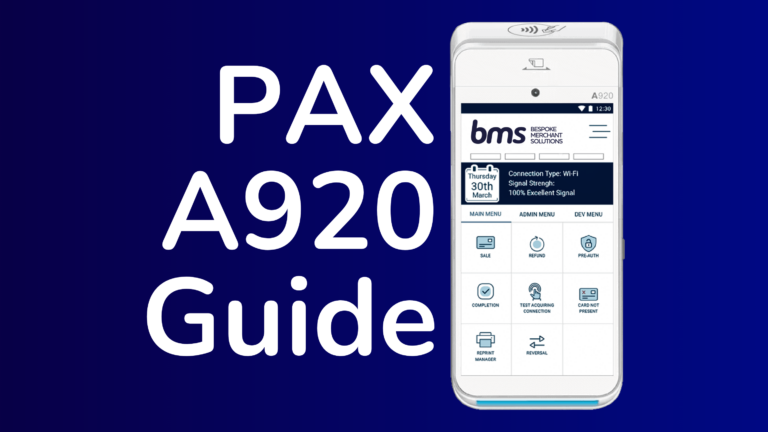
PAX A920 Guide
We want to ensure your employees are fully equipped with the knowledge on how to use the PAX A920. That’s why we’ve attached this helpful guide!
About BMS
This guide gives you a brief introduction to who we are and what we do at BMS. It delves into our services, our BMS membership, and more.

KYC Explained
This guide explains the principles of ‘Know Your Customer’, including what it is and how to prepare collecting the information that may be required.

EPOS Now Guide
This guide goes into detail about EPOS Now EPOS systems, how they work, who they’re suited for, and the benefits they have for your business.
Useful Blogs



How Do Card Payments Work?
When a customer makes a card payment, several processes happen behind the scenes to ensure the transaction is processed securely. While payment authorisation typically takes just a few seconds, multiple systems work together to make it happen. Here’s a simple breakdown of the process.
Customer Makes a Payment
The customer pays for something using their debit card, credit card or digital wallet, either through a card machine, online checkout or an alternative payment method.
Payment Authorisation
The payment details are securely transmitted through the payment processor and card network to the customer’s issuing bank, which checks whether the transaction can be approved.
Transaction Approval
The issuing bank approves or declines the payment, and the response is sent back to the business. If approved, the transaction is completed and the customer receives confirmation.
Payment Settlement
Approved transactions are submitted for settlement, allowing funds to be transferred to the business’s bank account. The time this takes depends on the payment provider.
Understanding The Merchant Industry
At BMS, we understand that the payments industry can seem overcomplicated and intimidating, that’s why we’re providing helpful resources to help you better understand some of the trickiest terms and guidelines.

PCI-DSS
PCI DSS stands for Payment Card Industry Data Security Standard.
It is a set of security standards designed to ensure that all companies who accept, process, or transmit credit card information maintain a secure environment for date processing.
PCI DSS is backed by all major debit and credit card companies such as VISA, Mastercard and American Express.
Transaction Fees
Transaction fees are a fee charged for each payment processed. It is typically a percentage of the transaction amount plus a fixed fee per transaction.
Conventionally, the transaction rate is between 1.5%-3%, but have been known to be as high as 6%. Additionally, the typical fixed fee is 20p per transaction.
For example; If a business receives a payment of £100 and the transaction fee is 2% plus a flat fee of £0.20, the transaction fee would be £2.20.
This doesn’t sound like a lot at first, however this fee is charged per transaction, therefore it will add up fast.


Terminal Rates
A terminal rental charge is a charge associated with the use of a physical POS system, (card machine) which has been provided by the merchant services provider.
This fee is typically a recurring cost, such as a monthly rental fee. It is usually between £14 to £35 per month, the cost of which is tied to whichever card machine the provider gives you.
Interchange Fees
Interchange rates are fees charged by the card-issuing bank, such as VISA or MasterCard, to the merchant’s bank every time a customer makes a credit or debit card payment.
These fees are a crucial part of the payment processing ecosystem, as they compensate the bank that issued the card for handling the transaction and the associated risks.
Interchange fees can only be increased by the card-issuing bank, however if they do increase, the merchant provider will adjust their prices to match.
Many people are wary of interchange fees due to the apparent lack of control that the merchant provider has over the rates, however they are typically only increased following a major world event such as Brexit.
Industry Links
PCI-DSS
PCI DSS Quick Reference Guide: Understanding the Payment Card Industry Data Security Standard version 3.2.1
Financial Conduct Authority (FCA)
The UK's financial conduct authority
Merchant Fees: Explained
A further explanation of merchant fees and a comparison to the fees we offer.
The Payments Association
An industry body supporting businesses across the payments sector through industry insights, guidance and collaboration.
Payment Systems Regulator (PSR)
The UK's payment systems regulator
Data Protection Act (DPA)
The UK's data protection laws.
Glossary
Getting started? These terms will help you find your way.
A small fixed charge for each request to approve a card payment, whether the transaction is approved or declined. When a customer pays by card, the terminal or payment gateway sends a request to the card issuer to check the card is valid and has enough funds. Authorisation fees are usually a few pence per transaction and are charged on top of the percentage-based transaction rate, so they can add up quickly for businesses with lots of low-value sales.
Buy Now, Pay Later is a payment option that lets customers spread the cost of a purchase over several instalments, often interest-free, while the business is paid upfront by the BNPL provider. The provider takes on the risk of the customer not paying and charges the merchant a fee for each transaction, usually higher than standard card fees. BNPL can increase average order values and conversion rates, especially for higher-priced items.
Problems that stop a card machine from taking payments properly. Common causes include connectivity issues (Wi-Fi, 4G or Bluetooth), low or failing batteries, damaged card readers or screens, out-of-date software, and paper roll jams. Many faults can be fixed by restarting the terminal or checking its connection, but persistent issues may need a replacement unit. A good merchant services provider should offer fast support and a quick swap so you don’t lose sales.
A reversal of a card payment that the cardholder starts by disputing the transaction with their bank. Common reasons include suspected fraud, goods or services not received, items not as described, or being charged twice. The money is taken back from the merchant’s account while the dispute is investigated, and the merchant can challenge it by providing evidence such as receipts, delivery confirmations or signed agreements. Providers usually charge a fee for each chargeback, and a high chargeback rate can lead to extra fees or the account being closed.
The fee the customer’s bank charges for each card transaction. It is usually the largest part of what a business pays to accept card payments. In the UK, interchange on consumer debit and credit cards is capped at 0.2% and 0.3% of the transaction value. Business cards, premium cards and cards issued outside the UK can carry higher rates. Interchange is passed on to the merchant through their acquirer, alongside scheme fees and the provider’s own margin.
A unique number given to a business by the bank or processor that handles its card payments. The MID identifies the business in every transaction, so funds are paid into the right account and transactions appear correctly on statements. A business with several locations or sales channels, such as a shop and a website, may have a separate MID for each. You’ll usually need your MID when contacting your provider about payments, statements or terminal issues.
Meeting the Payment Card Industry Data Security Standard (PCI DSS), a set of security rules for any business that accepts, processes, stores or transmits card data. Compliance involves protecting cardholder data, using secure systems and networks, and completing a yearly self-assessment questionnaire (SAQ). Businesses that aren’t compliant may be charged monthly non-compliance fees by their provider and can face serious penalties if a data breach occurs.
SME (Small and Medium-sized Enterprise) is a business below a certain size. In the UK, this generally means fewer than 250 employees. SMEs make up the vast majority of UK businesses and often lack the bargaining power of large companies when negotiating card processing rates, which is where an independent merchant services consultancy can help.
A security method that replaces a customer’s card number with a unique code, called a token. The real card details are stored securely by the payment provider, and the business only keeps the token. This lets merchants offer features like saved cards, one-click checkout and recurring payments without storing sensitive card data themselves. It also reduces the scope of PCI compliance requirements.
BMS is an Independent Sales organisation (ISO), meaning we have a direct relationship with multiple banks. We are able to create a truly bespoke package for our customers by recommending the best bank that matches your needs. Our direct relationships also mean that we are able to negotiate the best prices for our customers.
We provide a range of merchant services including merchant accounts, payment gateway integration, Point of Sale (POS) solutions, and e-commerce solutions. Our services are tailored to meet the specific needs of businesses of all sizes.
Getting started is easy! Simply book a consultation through our Contact Us page on the website. You can also call us at 0800 989 0142 or email us at [email protected]. We’ll set up a consultation to understand your needs and create a customised solution for your business.
We do not charge for the comparisons and analysis service of your current package, and we will always provide you with a free quote. We also promise that there will be no hidden charges, and everything will be explained to you. The team are always happy to help if you are unsure about anything!
The bank you have your business account with is the best place to start, right? Wrong! Most banks do not own their own card payment services. In fact, they simply partner up with a large card processor and resell their products. From our experience, these “direct with the bank” packages are the most expensive.
Get In Touch With BMS
Fill out the form below and one of our experts will get back to you as soon as possible. We look forward to helping you achieve your business goals!